
Is RED Dead? What the Rental Data Says About RED Cameras in 2026
Short answer: RED is not dead. RED as the default cinema camera is.
Ten years ago, if you were an ambitious filmmaker with a real budget and no ARRI money, you shot RED. That was the lane. Today that lane belongs to Sony, and the prestige lane belongs to ARRI and film. RED has moved to a narrower road: global shutter, 8K, high-speed, VFX plates, and live broadcast.
I run a cinema rental house in Fort Worth. Here is what we see, what the national data shows, and what one director learned the hard way about drive space. But first, a confession.
I used to love RED
I am not writing this as a RED hater. I am writing it as someone who owes them.
One of my very first short fashion films, a 2012 piece titled Driving Force, was shot on RED. It was recognized at RED's own Shot on RED film festival. That camera and that recognition gave a young director from Texas a real credit at a moment when the whole industry was deciding whether digital could be cinema.
RED settled that argument. Before the RED ONE, "digital" meant a compromise you apologized for. RED made a 4K raw camera a working DP could actually own, and it dragged the motion picture business from celluloid to digital faster than anyone in Hollywood was ready for. ARRI and Sony built better cameras because RED forced them to.
So I have fond memories, and I have the trophy. That is exactly why I think it is worth saying out loud: RED's golden era has ended, and unless something radical changes, it is not coming back.
Here is the evidence.
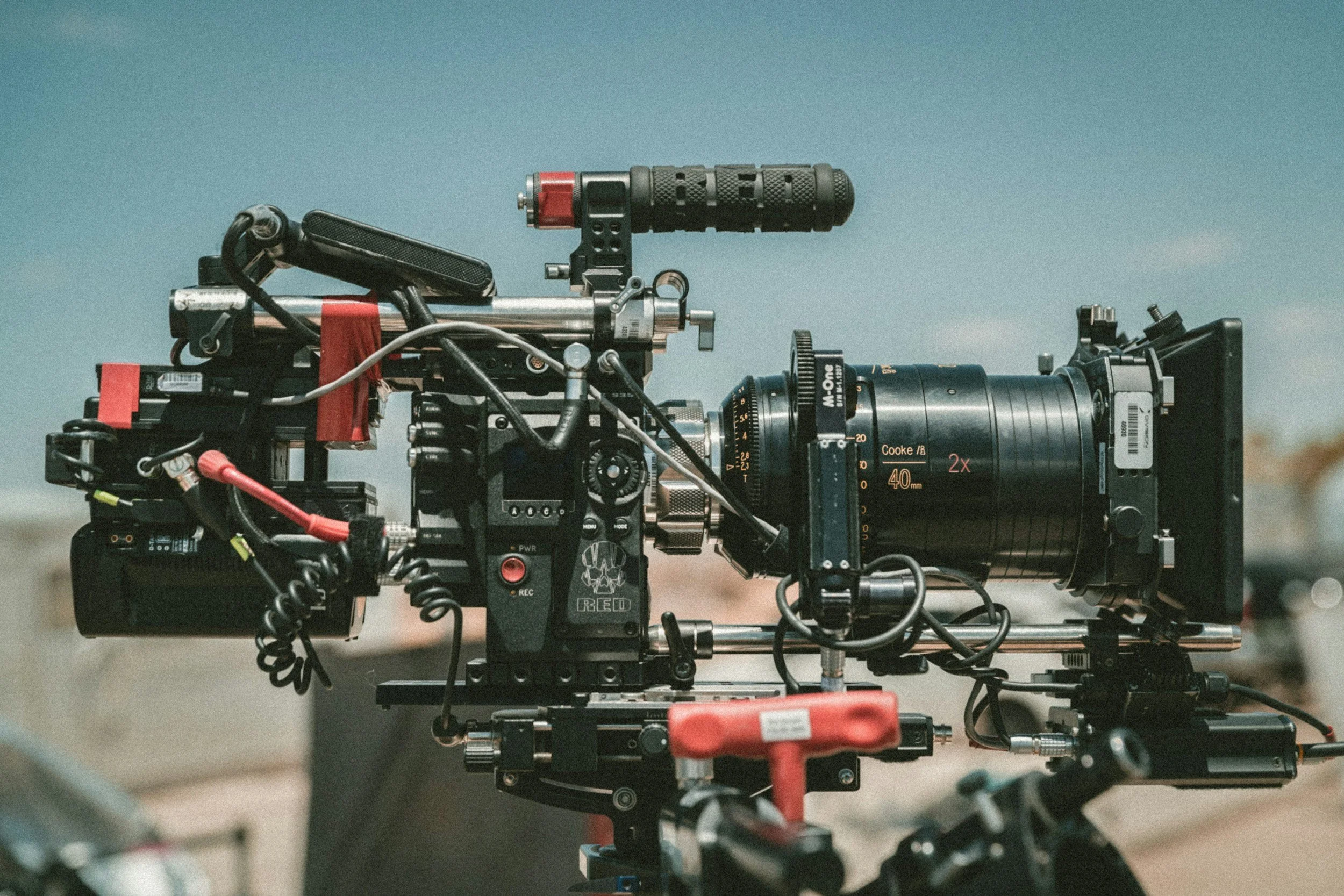
A RED DSMC2 rig on set. Ten years ago this was the default build for an ambitious indie. Photo by Jakob Owens on Unsplash.
What we see at the counter
I want to be honest about our data. Shine Cine opened in 2024, so our rental history is a few years deep, not a few decades. That skews things. A house that has stocked RED since the RED ONE still has customers who think in RED.
But here is the number that matters to me: nobody asks. Not for a Komodo, not for a V-Raptor. Producers call for a Sony VENICE 2, a BURANO, an ARRI ALEXA 35, or an FX6 package. Music video DPs ask about glass and lighting before they ask about a body. In a few years of taking calls, RED has not been the camera anyone was trying to find.
One rental house is an anecdote. So I went looking for bigger numbers.
What ShareGrid's data shows
ShareGrid publishes rental data across its marketplace. Their rankings are based on rental revenue, not vibes.
In 2023, the RED Komodo 6K was the fourth highest-earning product on the platform, right behind the Sony FX3, a7S III, and FX6.
In 2024 it dropped out of the top ten. In 2025 it was gone again. In the last 30 days, still gone. The 2025 top earners list is Sony bodies, Sony G Master zooms, and Aputure lights.
The Komodo also fell off the most-searched list. It was a top search term in 2024. In 2025 it was not.
Here is the part that stings. In ShareGrid's 2025 "Top Sold" list, the used gear people are unloading, RED shows up three times: the Komodo at number two, the DSMC2 Gemini at number five, and the Epic-W Helium at number nine.
On the biggest peer-to-peer rental platform in the country, people are selling their REDs, not renting them out.
What Lensrentals' data shows
Lensrentals publishes brand revenue share every December. RED's share of their rental revenue:
2023: 2.03%
2024: 1.27%
2025: 1.11%
Their 2024 write-up called it "RED's fall from grace" and tied part of it to the production slowdown after the strikes. Fair point. But Sony grew through the same slowdown, from 19% to nearly 22%. The work did not disappear. It moved to different cameras.
No RED body made the Lensrentals top 20 most-rented cameras list in 2024 or 2025. Nine of the top 20 in 2025 were Sony. The FX6 sat at number nine. Canon's C70 and R5 C made it. RED did not.
What the awards data shows
The Academy does not publish an official camera list, but Y.M.Cinema, RedShark, and British Cinematographer track every nominee. The picture is consistent.
Oscars 2026. Six of ten Best Picture nominees shot on ARRI. Three shot VistaVision film. The Sony VENICE 2 shot F1. RED appears once, as the secondary camera for miniature work on Frankenstein, which was primarily ALEXA 65.
Oscars 2025. RED appears once, a Komodo as a secondary camera on Emilia Pérez.
Golden Globes 2026. ALEXA 35 was the most-used camera. RED appears on two projects, both as secondary bodies.
Emmys 2026. Nine ARRI systems, six Sony systems, two RED systems. The two RED shows were Hacks and Ocean with David Attenborough.
Sundance 2026. ALEXA 35 shot 16 features. RED shot two, both alongside other cameras. Y.M.Cinema's read: RED systems appear "primarily in high-speed, compositing-heavy, or technically demanding sequences rather than as full-feature workhorses."
The last time a RED-shot film won the Oscar for Best Cinematography was Mank, on a custom RED Ranger Helium Monochrome, at the April 2021 ceremony. Since then, RED shows up on the nominee lists the way a Phantom does: for a sequence, not for the movie.
What RED and Nikon are doing about it
RED did not go quietly. It got bought.
Nikon closed its acquisition of RED in April 2024 for roughly $85 million. That is the number that made the industry pause. RED once wanted more than that for a single 8K sensor patent fight.
Since then, the moves have been pricing moves:
September 2024: Komodo cut to $4,995, Komodo-X to $6,995.
March 2025: Komodo cut again to $2,995.
September 2025: V-Raptor XE launched at $14,995, half the price of the V-Raptor X, with half the frame rates.
October 2025: a trade-in program giving Komodo owners $1,000 and Komodo-X owners $3,000 toward a Raptor.
February 2026: V-Raptor XE added to the Netflix approved list.
April and September 2026: RED's NAB and IBC showcases were about live broadcast, IP workflows, and multi-camera production, not a new cinema flagship.
Meanwhile, Nikon's own ZR, a $2,199 mirrorless body with RED color science and R3D recording, is one of the three cameras Nikon credits for its unit growth this year. Nikon's financial reports now call cinema a core growth initiative.
Read those moves together. RED technology is going into a $2,199 Nikon and into broadcast trucks. The RED brand is being repositioned as a global-shutter specialist at a lower price. That is a survival strategy, and probably a smart one. It is not the strategy of a company that expects to be the default camera on your next indie feature.
The director who turned down free REDs
A director I know is deep into a documentary with a long interview list. RED reached out and offered to provide cameras for the doc at no cost.
Free RED bodies. The director said no.
Not because of the image. Because of the media. He ran the math on how many interview hours he was looking at, what that footage would weigh in R3D, and what hard drives cost in 2026. Then he went and got some Sony FX6s.
He has filled about 12 terabytes of drive space with interviews so far. That is roughly 110 hours of 4K interview footage at the FX6's standard XAVC-I setting.
The same 110 hours on a RED, depending on the body and compression setting, lands somewhere between 6X and 14X more data. Call it 10X. Instead of backing up 12 terabytes twice, he would be backing up 120 terabytes twice, in a year when hard drive prices are up roughly 46% since last fall and the big drive makers are sold out through 2026 because AI data centers bought the supply.
For an interview doc, that extra data buys nothing the audience will see. It buys drives, transfer time, and a DIT bill.
That is the RED problem in one story. The image was never the issue. The workflow tax is.
So has the ship sailed?
Here is my take as a rental house owner who started on RED and still roots for them.
RED is not dead. The V-Raptor is a legitimate camera. Global shutter matters for LED volumes, drone work, high-speed, and anything with strobes or screens. It is Netflix approved. Hacks and Attenborough shoot on it. Nikon has money and a reason to keep it alive.
RED as the default is gone. The middle of the market, the commercials, music videos, docs, branded content, and indie features that make up most of the work in Fort Worth and DFW, moved to Sony. Sony gave crews full-frame, great autofocus, internal NDs, small files, and a body every AC already knows. ARRI kept the top. RED got squeezed.
The used market already voted. When the Komodo, Gemini, and Helium are top sellers on ShareGrid and the Komodo has dropped from about $6,000 to $2,995 in under two years, owners are telling you where the value went.
The right way to think about RED in 2026 is as a specialty rental. You spec it for a reason: global shutter, 8K plates, high frame rates, a specific look a DP wants. You do not spec it because it is what serious people shoot. That is what it was in 2015. It is not what it is now.
What this means for your next project
If you are building a package in North Texas, here is the honest rental house answer:
Interview-heavy doc, branded content, corporate: FX6 or FX3 class. The data savings alone pay for lighting.
Commercial or music video with a real DP: Sony VENICE 2, BURANO, or ARRI ALEXA 35. That is what the reels are cut from.
LED volume, high-speed, VFX plates, strobe-heavy work: now RED earns its spot. Ask for it on purpose.
Send us the complete gear list and tell us what you're shooting. We will build the package around the work, not the logo on the body. And if the answer is a RED, we can source one.
Frequently asked questions
Is the RED camera company still in business?
Yes. Nikon bought RED Digital Cinema in April 2024 for about $85 million. RED still sells the Komodo, Komodo-X, V-Raptor, and V-Raptor XE lines and is pushing into live broadcast.
Why did RED cameras lose popularity?
Sony's FX line gave working crews full-frame, autofocus, internal ND, and small files at a lower price. ARRI kept the high end. RED's large R3D files and higher cost made it harder to justify for docs, commercials, and indie work.
Do professionals still use RED cameras?
Yes, mostly for specific needs: global shutter, 8K, high frame rates, LED volumes, and VFX plates. RED appeared on two 2026 Emmy-nominated series and as a secondary camera on a 2026 Best Picture nominee.
How much more data does a RED shoot than a Sony FX6?
At standard settings, a Sony FX6 in 4K XAVC-I writes about 108 GB per hour. A RED Komodo 6K in R3D HQ writes about 860 GB per hour. A V-Raptor 8K in HQ writes about 1.5 TB per hour. That is roughly 8X to 14X more storage.
Can I rent a RED camera in Fort Worth?
Shine Cine can source RED bodies through our rental partner network when a project needs one. Send us your gear list and we will confirm availability.
Sources
ShareGrid Insights (top earning, most rented, top sold, and top searches, 2023 through the last 30 days)
Lensrentals, Top Photography and Videography Rentals for 2025
RedShark, cameras behind the 2026 Oscar Best Picture nominees
No Film School, Komodo and Komodo-X price cuts, September 2024