
Fort Worth Is a Film Town Now. Here’s How We Keep It One.
The one-minute version
Texas is spending $1.5 billion over ten years to build a film industry, and thanks to Taylor Sheridan, The Chosen, and a run of films that picked this city, a big piece of it is landing in Fort Worth. That is worth celebrating, and I do, every day I unlock the shop.
Here's the thing most people don't think about. The incentive pays the same whether a production rents from a hometown rental house or from a national company's Texas branch. The difference is what happens to the profit. A branch sends it upstream to shareholders or an investment group in another state. A locally owned house spends it here and puts it right back into gear.
That matters because an incentive buys production activity, and production activity is temporary. Louisiana, Florida, North Carolina, and Michigan all watched national vendors pack up and crews leave within a year or two of cutting their programs. What outlasts the activity is whatever the local vendors were able to buy while it was here. Gear on a truck leaves with the truck. Gear owned by a Fort Worth company stays in Fort Worth, because the owner isn't going anywhere.
Why it matters: the profit a local house earns on a studio show gets spent here, on local staff, local vendors, and local taxes, and then it turns into gear that's still on the shelf after the show wraps. That's the ALEXA the film student rents for her short, the lens set a DP tests in the prep bay on a Saturday, the package a local house can cut a break on because the owner wants to see the movie get made. That's the difference between an incentive that passes through Fort Worth and one that builds it.
Camera orders don't get placed by studios. They get placed by people, and most of them live in the Metroplex. If that's you, two things:
Send the list to a local house first. Not instead of the national house, first. Same lead time. Let us tell you what we can cover and what we'd source.
Let the local house sub-rent the gaps. If a Fort Worth company covers 70 percent of the package and sub-rents the rest, the whole invoice is Texas spend, the profit on the 70 percent stays here, and the shop learns exactly what to buy next.
And to Paramount and the other studios spending the grant: when 1883 rolled into town in 2021, there wasn't a Fort Worth cinema camera house to call. I get it. Now there is. Give local rental houses a shot at the package, with the lead time to buy for it. A committed show is the guarantee a local house needs to put a purchase order in, and the gear we buy for your show stays here for every Fort Worth filmmaker who comes after.
The rest of this article is the evidence.
The full story
Fort Worth is a film town now, and I love it
I spent about thirty years in production before I opened Shine Cine, twenty of them running a commercial production company in Dallas, and I never thought I'd see what's happening in Fort Worth right now. Taylor Sheridan gets the headline, and he's earned it. He brought 1883 here in 2021 and spent $44 million in 74 days, then came Lawmen: Bass Reeves, Lioness, Landman, The Madison, and a studio campus at AllianceTexas with room for ten stages. Landman season two alone carried more than a thousand crew, and Sheridan's productions hired around 15,000 people in Texas in 2025.
But he didn't build this town alone. The producers behind The Chosen, Out of Order Studios, are a Fort Worth company, and that show has been shooting in North Texas since 2020, first in Weatherford and now on its own campus in Midlothian, with a Fort Worth crew base underneath it. Robert Redford shot The Old Man & the Gun in Sundance Square. Miss Juneteenth was made entirely here. 12 Mighty Orphans filmed at Farrington Field and the Masonic Temple. The Fort Worth Film Commission has supported more than a thousand projects and a billion dollars in economic impact since 2015. The mayor calls film the city's next great industry, and she's right.
Then the state stepped up. Senate Bill 22 committed $1.5 billion to the Texas Moving Image Industry Incentive Program over ten years, up to 31 percent back on qualified Texas spend. The money is here, the shows are here, and the crew base on this side of the Metroplex has never been deeper.
I want to say something plainly before I say anything else. When 1883 showed up, there was no Fort Worth cinema camera rental house to call. Camera packages came from Dallas, Atlanta, and Los Angeles because that's where the packages were. Nobody did anything wrong. You can't rent from a shop that doesn't exist yet.
That shop exists now. That's the whole reason for this article.
This isn't a complaint about the big boys
Let me be clear about what this is and isn't. This is not a complaint about national rental houses doing their thing. Some of them are excellent, we sub-rent from them, and they've kept a lot of Texas crew working. The people in their Fort Worth locations are our neighbors.
This is a local owner making the case for shopping local. It's an appeal to the people who actually decide where a camera order goes, the coordinators, UPMs, DPs, and first ACs who live here, and it's an appeal to the studios spending the incentive money to build the local vendors up while the money is flowing. Because the gear a local vendor buys is the part of the incentive that stays.
The grant doesn't care who owns the truck. You should.
The program guidelines are simple about vendors. An expense qualifies when it's "paid to a Texas vendor (valid physical TX address and/or phone #)," with an invoice and proof of payment. A proposed rule published in February 2026 tightens that to a "Texas Domiciled Entity" with "a physical business location at a verifiable Texas address, other than a P.O. Box."
So a national house that opens a Fort Worth location is a Texas vendor for grant purposes, and it should be. The Legislature's goal, in Senator Joan Huffman's words, was that the spending is "all Texas based, and it all has to be tied to impact in the state of Texas." Senator Phil King of Weatherford described what the bill was meant to feed: "the small jobs, the opportunities, the restaurants that are full, the equipment rentals."
The grant does its job the moment a Texas address is on the invoice. What happens to the money after that isn't the grant's job. It's the production's choice, and that choice is the point of everything below.
Follow the profit upstream
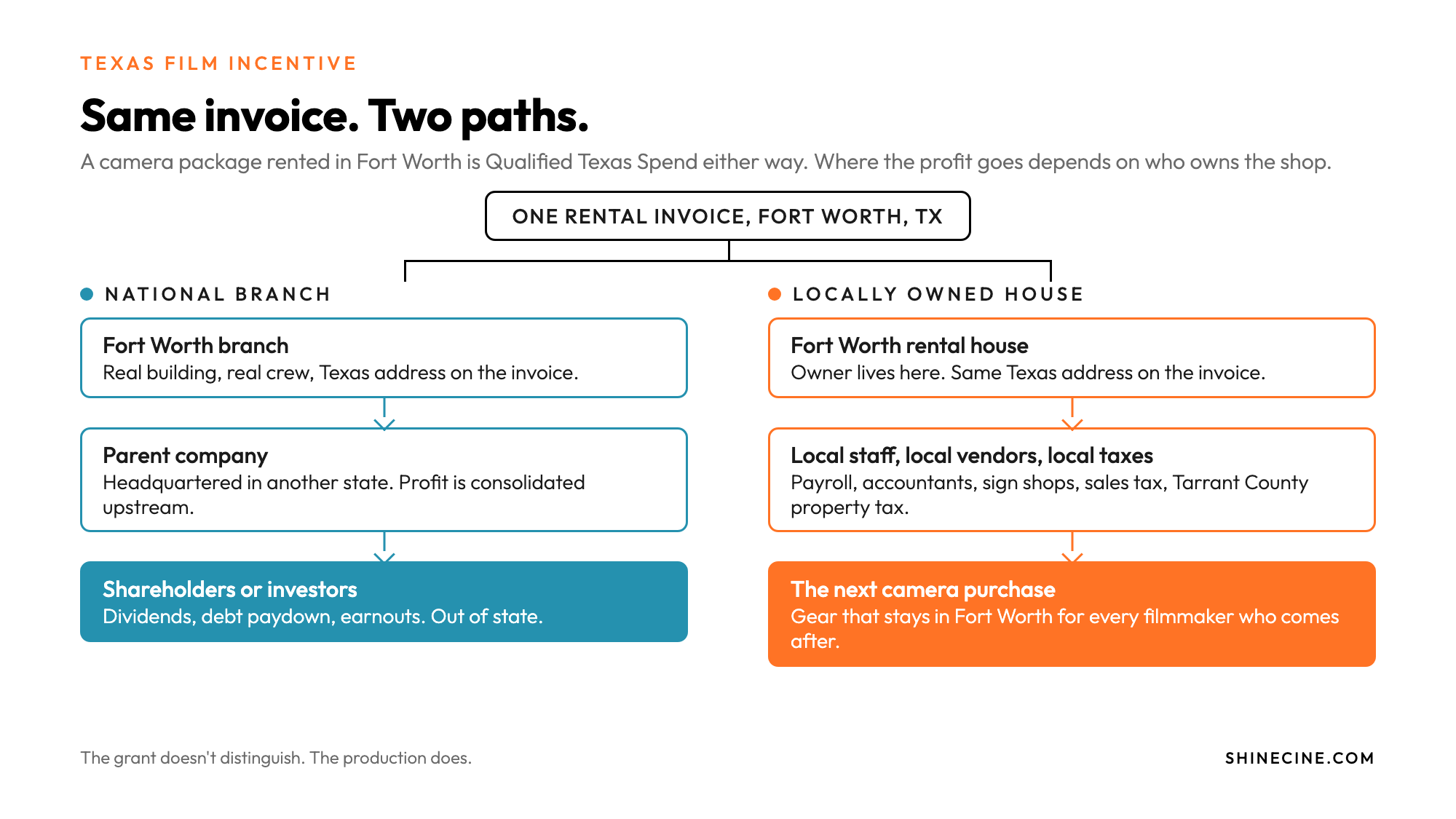
Two national houses opened Fort Worth locations in the fall of 2024, right as Sheridan's shows had turned this into a full-time production town. Both are good companies. Here's where their Fort Worth profit goes.
Cinelease opened a 25,000 square foot lighting and grip house on Will Rogers Boulevard in November 2024, and it's a real facility with real crew. Cinelease has served Texas from Austin for well over a decade. Now look at the ownership chain over that same stretch. Hertz bought Cinelease in 2012. Herc Holdings, the equipment rental company spun out of Hertz and headquartered in Bonita Springs, Florida, inherited it. In October 2023 Herc announced it was exploring a sale. In the fourth quarter of 2024, the same quarter the Fort Worth branch opened, Herc wrote Cinelease down by about $194 million, then by another $49 million in mid-2025. On July 31, 2025, Herc sold Cinelease to Zello, a private investment platform in Burbank, California, for $100 million in cash plus earnouts tied to Cinelease's revenue in 2027 and 2028. Herc used the money to pay down debt and paid its shareholders $87 million in dividends that year. In September 2026 Cinelease bought the grip, lighting, and production supply assets of Quixote.
None of that is wrongdoing. It's how a consolidated company works. But every dollar of profit from the Fort Worth branch belongs to whoever owns the parent that year: public shareholders in 2024, a Burbank investment group today, and whoever collects the earnouts in 2028. The branch doesn't get to keep it.
Keslow Camera, founded in Culver City in 1990 and self-described as the largest privately held cinema camera rental house in North America, added a Fort Worth listing to its website between August and November 2024. For nearly two years the address was a suite in a downtown shared-office building. By September 2026 it had moved to a flex industrial unit off I-35W in north Fort Worth. Keslow's COO said this August that the company had handled "numerous projects for Taylor Sheridan out of our Texas office," and back in 2018 he described the strategy as "having a presence in the locations they're shooting in, wherever possible."
That's a smart way to run a national rental company, and Keslow has a deep inventory. It's also privately owned in California, which means Fort Worth profit lands in California. There's no version of a branch, however good the people in it, where the profit stays in the ZIP code.
What $100 does when it stays home
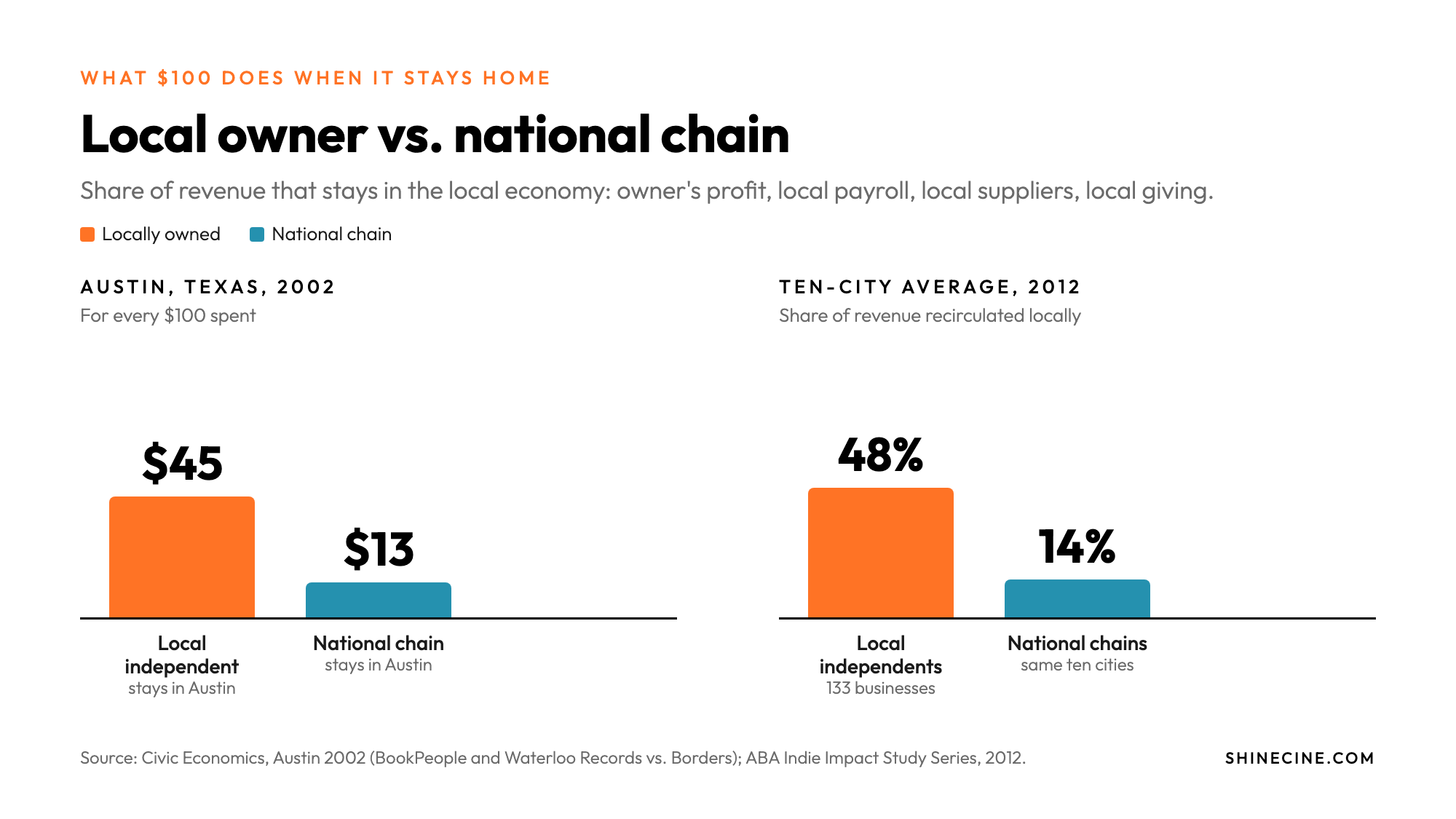
Now take a rental house that was founded, owned, and managed by people who live in the Metroplex. The research on this is older than the film incentive and it's remarkably consistent. Civic Economics has run the same study in more than a dozen cities and found that independent retailers recirculate about 48 percent of revenue in the local economy versus about 14 percent for national chains. The very first of those studies was in Austin, in 2002: for every $100 spent at a national chain, $13 stayed in the Austin economy. At the locally owned competitor, it was $45. The City of Fort Worth's own economic development plan says the same thing in plainer words: "Independent, locally-owned firms also recirculate a higher share of their revenue in the local economy, compared to national chain businesses."
The mechanism isn't mysterious. A local owner pays local staff, hires a local accountant and a local sign shop, banks locally, gives to local causes, and spends the profit here. Texas has no state income tax, so the tax that ownership pays is the tax that shows up in the building: sales tax on every rental at Fort Worth's 8.25 percent combined rate, franchise tax, and business personal property tax on every camera body, lens, and light stand in inventory, rendered to the Tarrant Appraisal District every April and paid to the city, the county, and Fort Worth ISD. A branch pays sales tax and property tax too, and I'm glad they do. The difference is the profit line, and the profit line is what buys the next ALEXA.
Four states learned this the hard way
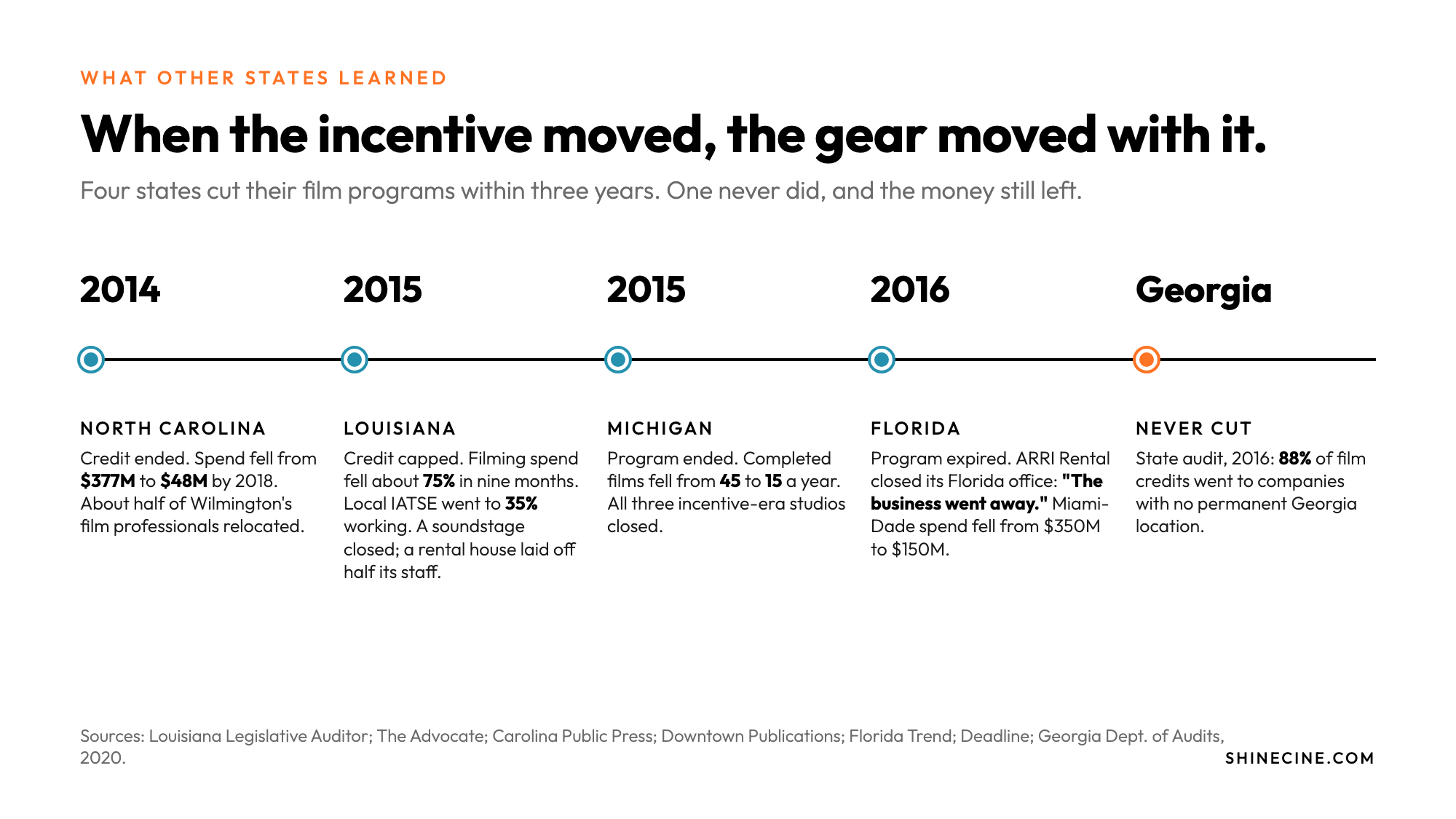
Texas isn't the first state to fund a film industry. It's the first to do it after watching what happened to the others, and the pattern is the same everywhere. It's not a knock on any company. Mobile capital moves.
Louisiana capped its credit at $180 million in 2015. In the first nine months of the following fiscal year, filming spend fell from $1.2 billion to $225 million, about 75 percent. IATSE Local 478 went from nearly full employment to 35 percent working. FilmWorks soundstage in New Orleans closed, and Silver Screen Group, a New Orleans rental house, laid off half its staff. Keslow's New Orleans location disappeared from its website between September 2016 and April 2017, then reopened in May 2018 when the state's production numbers came back. Louisiana cut the cap again in 2025, and Quixote closed its New Orleans facility that January "due to reduced production activity in the market."
Florida let its program expire in 2016. ARRI Rental closed its Florida office that year, and its vice president put it as directly as anyone has: "The office is closing because the business went away." Miami-Dade production spending fell from about $350 million a year to $150 million. Keslow's Miami location came off its website in the same window and never came back.
North Carolina ended its credit at the close of 2014. Statewide spend fell from $377 million in 2012 to $127 million in 2015 and $48 million in 2018. By 2018 roughly half of Wilmington's film professionals had moved to Atlanta, New York, or Los Angeles.
Michigan cut its program in 2011 and ended it in 2015. Completed films fell from 45 in 2010 to 15 the next year. IATSE Local 38 lost about 200 members to other states in a single year, and all three studios built during the incentive era closed, including the Pontiac studio whose bonds the state pension fund had guaranteed.
Georgia is the cautionary tale in the other direction, because Georgia never cut its credit and the money leaked out anyway. The state auditor found that in 2016, 88 percent of Georgia's film credits, $588 million of $667 million, went to companies with no permanent Georgia location. The auditor's explanation is the whole argument in two sentences: "Due to the mobile nature of filming, a company can move the production location of a movie or television show without changing the company's location. Once the incentivized project is completed, the economic activity related to the production ends." When Georgia's production spending fell from $4.4 billion in fiscal 2022 to $2 billion in fiscal 2026, Quixote closed its Atlanta and New Mexico operations and laid off about 70 people.
Massachusetts publishes the cleanest number of all. In 2013, 58 percent of the spending generated by its film credit went to non-residents and out-of-state businesses.
The lesson isn't that incentives fail. Texas did this right, and I'm grateful for it. The lesson is that an incentive buys production activity, and production activity is temporary. What outlasts it is whatever the local vendors were able to buy while the activity was here. Gear on a truck leaves with the truck. Gear owned by a Fort Worth company stays in Fort Worth, because the owner isn't going anywhere.
The gear that stays is the gear young filmmakers get to use
This is the part that matters most to me, and it's the part the economic studies don't measure.
When a local rental house buys a camera package to support a studio series, that package is still here after the series wraps. The 22-year-old who just moved back from film school can rent it for a short. The DP shooting a passion project on a weekend can build it in a prep bay, test lenses, and ask questions of people who've used them on set. A local house can decide to give a film student a break on a three-day rental because the owner met her at an event and wants to see the movie. A branch can be run by wonderful people and still have no mandate to do that. The pricing comes from somewhere else, and so does the decision about whether the Fort Worth location is worth keeping open next year.
Studio deals change, too. Taylor Sheridan's next television deal moves to NBCUniversal when his Paramount contract ends in 2028, and Paramount's own headquarters has been a live question this summer. Fort Worth has never had this much production, and I hope it has more in five years. But the rental houses that were founded here will still be here either way. The incentive can build a permanent film community in this city, but only through the vendors that are permanent.
You're the one placing the order
Camera orders don't get placed by studios. They get placed by people, and most of them live in the Metroplex.
The production coordinator and the UPM set up the vendor accounts and route the paperwork. The DP picks the camera and the glass. The first AC builds the list, walks the prep, and has a strong opinion about where they want to prep. On a lot of shows, the local coordinator and the local AC have more say over where a camera package comes from than anyone in Los Angeles.
If that's you, here's the ask:
Send the list to a local house first. Not instead of the national house, first. Give the local shop the same lead time and let them tell you what they can cover and what they'd source.
Let the local house sub-rent the gaps. If a Fort Worth company can cover 70 percent of the package and sub-rent the rest, the whole invoice is Texas spend, the profit on the 70 percent stays here, and the shop learns exactly what to buy next.
Compare the final number, not the rate card. Published Rates from a local house are usually the real rates. Compare the total for the full package, including prep days, delivery, and what happens when something breaks at 5 a.m.
Tell the local house what you'll need next season. A show with a known schedule is the single biggest thing that lets a local vendor buy equipment. A two-line email in January changes what's on the shelf in June.
Dallas-Fort Worth has strong camera and grip houses owned by people who live here. Explore them. Ask who owns them. It's a fair question, and the answer tells you where the money goes.
A few to start with, all owned by people who live here:
MPS Studios, Dallas. Founded by Mark Beasley in 1979, who built the first grip truck in Texas, and still owned and run by the Beasley family. Stages, camera, lighting, and grip on Regal Row.
4:4:4 Camera, the camera division of Dallas-based Electric Light & Power. Owner-operated since the 1980s, with a deep cinema camera inventory in Dallas and Austin.
Shine Cine, Fort Worth. That's us. Cameras, glass, G&E, and prep bays at 911 S. Main.
Paramount, here's the ask
The Texas Moving Image Industry Incentive Program was written to build a Texas industry, and the studios collecting the grant have a real chance to make that permanent. It doesn't cost them anything they aren't already spending.
Give local rental houses a shot at the package, with the lead time to buy for it. A committed show is the guarantee a local house needs to put a purchase order in. The scale is already here. Fifteen thousand hires in a year, a thousand crew on a single season of Landman, ten stages coming at Alliance. That's enough to build permanent camera and G&E infrastructure in Fort Worth, if some of it runs through companies that will still be here after the last season.
Shine Cine is a few years old. A large share of our profit goes right back into gear that stays in this market for years, for every new filmmaker who comes through the door, and with a committed show we could expand our camera, lens, and support inventory in a serious way. That inventory would then be available to every Fort Worth filmmaker at real published rates for as long as we own it, which is for good. We're one example. Every locally owned house in the Metroplex can say a version of the same thing.
The state is making a ten-year bet on Texas film. The way to collect on that bet is to make sure the vendors that benefit from it are the ones that can't leave.
Give us a shot
When Taylor first moved in, there wasn't a local Fort Worth camera house. Now there is, and it's three miles from the Stockyards with prep bays, published rates, and a team that's spent its whole career on set. Bring on a production. Send us the list.
See cameras and pricing or get in touch.
Chris Rupert, founder, Shine Cine Camera Rental House, Fort Worth, TX
FAQ
Does renting from a national rental house's Texas branch count as Qualified Texas Spend?
Yes. The program guidelines require a Texas vendor with a valid physical Texas address or phone number, an invoice, and proof of payment. A branch qualifies. The grant doesn't distinguish between local ownership and out-of-state ownership.
Then why does local ownership matter?
Because the grant covers the transaction, not the profit. A locally owned house keeps its profit in the Metroplex and reinvests it in equipment that stays here. A branch sends its profit to a parent company. Studies of local versus chain businesses consistently show independents recirculating roughly three times as much revenue locally.
What happens to rental inventory when a state's incentive ends?
Historically, national vendors reduce or close locations and move inventory to the next market. Louisiana, Florida, North Carolina, and Michigan all saw vendor closures and crew departures within a year or two of cutting their programs. Locally owned inventory stays because the owner lives there.
How can a local crew member help?
Send the gear list to a locally owned house first, with the same lead time. Let them sub-rent what they can't cover. Compare the final package number rather than the rate card. Tell the local house what next season looks like so they can buy for it.